
nanobot
A small self-hosted Python assistant that works through a web page, a terminal or your chat apps.
Instead of Hosted AI assistants and agents
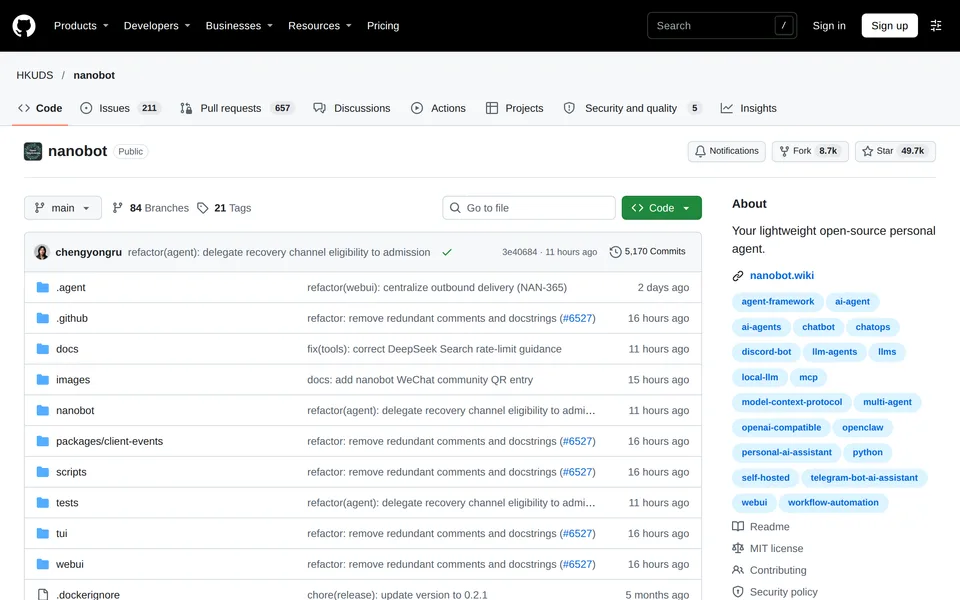
Screenshot from github.com/HKUDS/nanobot, taken 2026-10-30, shown to help you recognise the tool. It belongs to its maker. Ask us to remove it.
Most people want an assistant that waits in the chat apps they already use and does not need a data center, and nanobot is built for that. The README calls it an ultra-lightweight, open-source, self-hosted personal AI agent framework in Python, and it works from a browser page, a terminal, or Telegram, Discord, Slack, WeChat, Feishu, Teams, email, Mattermost and Linear. It can use local models through Ollama or vLLM, and it keeps memory, schedules jobs and calls tools for files, the shell, the web and MCP.
nanobot scores a 5 on lock-in and self-direction and a 4 on footprint, power, longevity and delivery.
The code is MIT licensed and the maintainers listed are Xubin Ren and Yongru Chen of the HKUDS organization. The first-run web page binds to localhost by default and is not exposed to your network, and we found no telemetry statement. It needs Python 3.11 or newer, and like any agent it acts with the logins you give it, so keep its access narrow.
- A self-hosted assistant for a web page, a terminal and nine chat apps
- MIT licensed, with local models through Ollama or vLLM
- The web page listens on localhost by default
What stands out
Do you make nanobot? Get the badge for your site
This badge reports a dated review. It is not a certification and it costs nothing. Link it to this page and leave the numbers alone: the image always shows the current score.
For dark backgrounds, use nanobot-dark.svg in place of nanobot-light.svg.
Other tools for “get an assistant that works for me”
 IronClawA Rust assistant that runs untrusted tools in WebAssembly sandboxes and says it collects no telemetry.
 MoltisA single Rust program that runs a persistent assistant on your own hardware, with every command sandboxed.
 OpenClawAn open-source AI assistant that runs on your own computer and works through your chat apps.
 Hermes AgentAn open-source AI agent that learns skills from the tasks it does and remembers you.
 NanoClawA small assistant that runs each agent in its own Linux container and keeps credentials outside it.