Home / What is conviviality?
What is conviviality?
A word from an old book, and a useful test for the software you use every day.
A convivial tool leaves you more able to do things for yourself. Ivan Illich used the word in 1973 for tools that anyone can pick up, use for their own purposes, and walk away from.
A convivial tool is one that
- anyone can learn by using it
- you can bend to your own purposes
- lets you leave with your own stuff
- needs you less than you need it
The opposite is a tool that
- only works inside a system you can’t see or leave
- decides what you may do with it
- gets harder to live without the longer you use it
A hammer and a bicycle are convivial, because anyone can use them, repair them and find uses their makers never imagined.
Illich saw six ways tools go wrong
- Biological degradationbecomes our Footprint question
- Radical monopolybecomes our Lock-in question
- Overprogrammingbecomes our Self-direction question
- Polarizationbecomes our Power question
- Obsolescencebecomes our Longevity question
- Frustrationbecomes our Delivery question
Those six became the six questions on How we score.
Why it fits software
- Accounts are hard to leave and files sit in formats only one company reads.
- Feeds are built around what keeps us scrolling.
- A small tool that does one job and lets you walk away with your files is convivial in exactly Illich’s sense, and so is a large open-source project with the same habits.
- Cheap AI-assisted building means more people can now make a small tool for themselves and their friends, which is how tools were supposed to feel all along.
What conviviality is not
- Free, open source or small, though those often help.
- Against technology. Illich argued for tools that serve people, and he was fine with sophisticated ones.
- Decided by who made the tool. A big company can build a fairly convivial one, and a charming indie app can still lock you in, so each review scores the actual tool.
Read the book
This is our own short reading, and Illich's book says it better. You can find it in a library near you, buy it from an independent bookshop through Bookshop.org, or order it from a local bookshop. When you're done, browse the directory and start with the tools rated Convivial.
Improve your conviviality score
A free 12-page PDF for people who make software: twelve changes that move the score, what reviewers look at for each question, a plain answer on money, and a worksheet.
Download the PDF PDF, 12 pages Read the summaryKeep going
Videos, essays and papers that take the idea further.
 EssayChris Krycho, 2026Computing, ConviviallyComputers can be a bicycle for the mind when they support real thinking, and harmful when they replace it. How do we shape them into convivial tools?↗PaperStephen Kell, 2020Convivial Design Heuristics for Software SystemsDesign rules for programming systems drawn from Illich, such as keeping systems small and favouring referencing over defining.
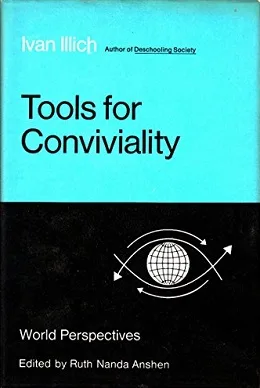 ReferenceWikipediaTools for ConvivialityA summary of the 1973 book, how it was received and how its ideas spread into degrowth and appropriate technology.