
Zotero
Collects, cites and organises your research sources, and keeps them yours.
Instead of EndNote, Mendeley, Google Scholar libraries
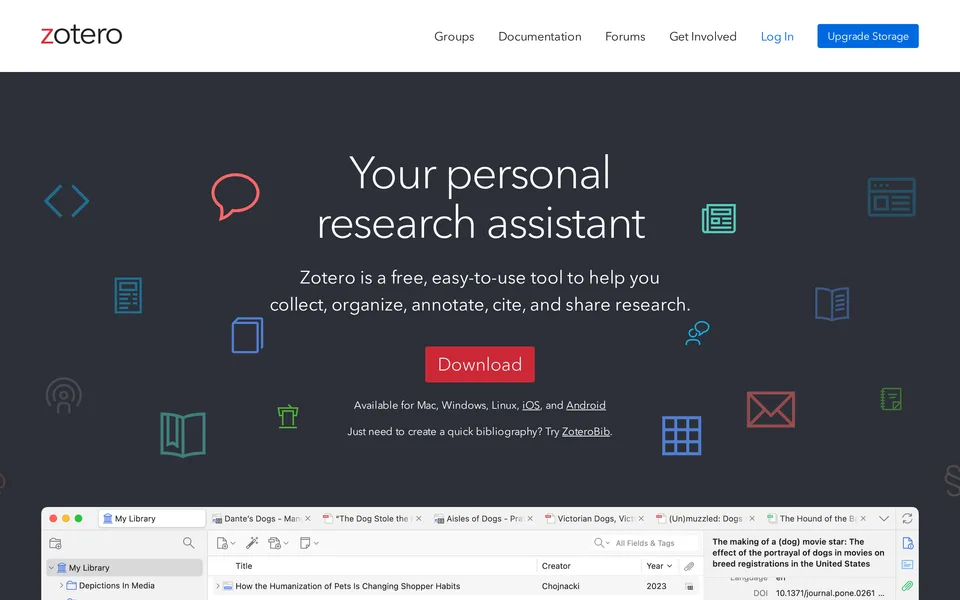
Screenshot from www.zotero.org, taken 2026-10-30, shown to help you recognise the tool. It belongs to its maker. Ask us to remove it.
Suppose it is two in the morning, a bibliography is due, and the sources you meant to keep track of are sixty browser tabs and a folder called final_final. Zotero is the card catalogue you wish you had started in September, where each card carries the details of a source, your notes on it and a copy of the thing itself. It began at George Mason University and is now built by the Corporation for Digital Scholarship, a non-profit, and you save a web page, a paper or a book with one click, after which it keeps the details, your notes and a copy on your own computer. It runs on Windows, Mac, Linux, iOS and Android.
Its money comes from research foundations, donations and optional storage subscriptions, so nobody earns more from you by keeping you inside it. It scores a 5 on lock-in, power, longevity and delivery and a 4 on footprint and self-direction. Your library exports to standard formats, and the one thing that asks for money is storage: the free allowance is small enough that heavy users will pay, and that payment is what keeps the project independent.
Portability is part of its history. In 2008 a rival company sued over Zotero's ability to convert its style files, and the case was dismissed in 2009, a fact we take from news reports of the ruling.
Day to day it is a library that grows as you read. You click, the source lands in your collection with your notes beside it, and the copy sits on your own machine whether or not you ever pay for storage.
- Saves a web page, paper or book in one click and keeps your notes
- Built by a non-profit, with a copy of your library on your own computer
- Won a court case over letting you move your style files
What stands out
Do you make Zotero? Get the badge for your site
This badge reports a dated review. It is not a certification and it costs nothing. Link it to this page and leave the numbers alone: the image always shows the current score.
For dark backgrounds, use zotero-dark.svg in place of zotero-light.svg.
For comparison, we also reviewed Pinterest (13/30) as a benchmark.
Other tools for “collect and connect ideas”
 ExcalidrawA browser whiteboard for sketching diagrams that look hand-drawn.
 AnkiFlashcards that use spaced repetition to help you remember.
 DatasetteTurns a database file into a browsable, shareable website.
 Are.naA quiet place to collect things and connect ideas over time.
 wallabagSave articles to read later, without the tracking.
 LinkwardenSave links and keep a copy of each page, in collections you control.