
Anki
Flashcards that use spaced repetition to help you remember.
Instead of Quizlet
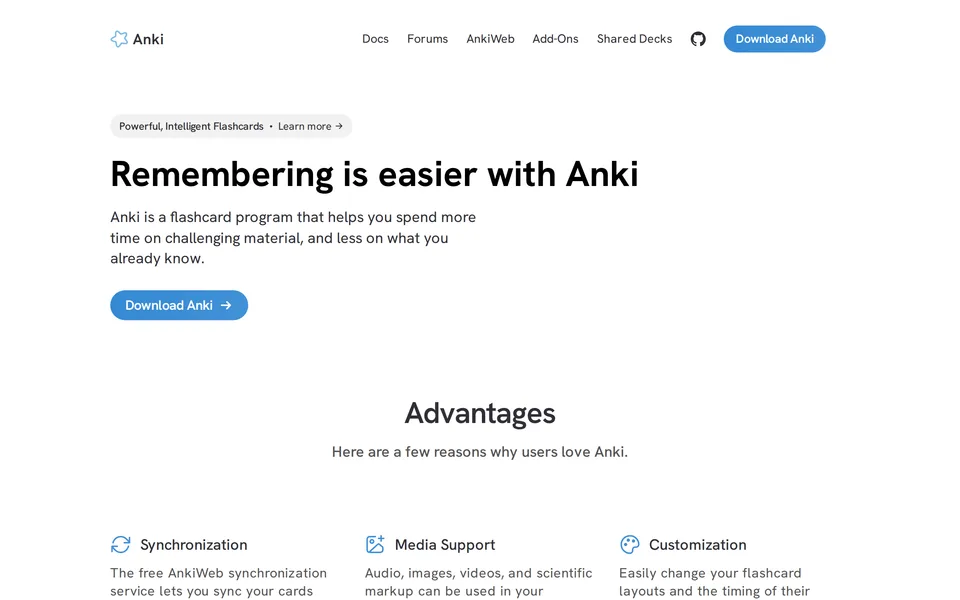
Screenshot from apps.ankiweb.net, taken 2026-10-23, shown to help you recognise the tool. It belongs to its maker. Ask us to remove it.
Most people have crammed for something and found it gone a month later, and in the 1970s a German science journalist named Sebastian Leitner devised a method for that: a box of index cards divided into compartments, where a card you remembered moved forward to a compartment you checked less often and a card you missed went back to the start. Anki gives that idea a computer to do the sorting. It shows you each card just before you would forget it, and it has become a standard tool for learning languages, medicine and much else. It is open source, it runs on Windows, Mac, Linux, Android and iOS, and your decks are files you can move.
Decks are files, so you can carry them somewhere else, and Anki scores a 5 on lock-in, self-direction and longevity and a 4 on footprint and power. What it asks of you is some tolerance for a plain look, since the interface is not pretty.
Money enters in one place. The desktop version is free and the iOS app is paid, and the payment helps fund the project, so anyone who studies on an iPhone should expect to buy the app. Together with the plain look, that leaves Delivery at 4.
A deck is a file, so a language you have been drilling for a year can come along when you change computers, and the daily routine is short: open it, answer what it shows you, and leave the scheduling to it.
- Spaced repetition helps you remember what you learn
- Decks are files you can move
- The iOS app is paid
What stands out
Do you make Anki? Get the badge for your site
This badge reports a dated review. It is not a certification and it costs nothing. Link it to this page and leave the numbers alone: the image always shows the current score.
For dark backgrounds, use anki-dark.svg in place of anki-light.svg.
For comparison, we also reviewed Pinterest (13/30) as a benchmark.
Other tools for “collect and connect ideas”
 ZoteroCollects, cites and organises your research sources, and keeps them yours.
 ExcalidrawA browser whiteboard for sketching diagrams that look hand-drawn.
 DatasetteTurns a database file into a browsable, shareable website.
 Are.naA quiet place to collect things and connect ideas over time.
 wallabagSave articles to read later, without the tracking.
 LinkwardenSave links and keep a copy of each page, in collections you control.