
eSpeak NG
A compact speech synthesizer that covers more than a hundred languages and accents.
Instead of ElevenLabs
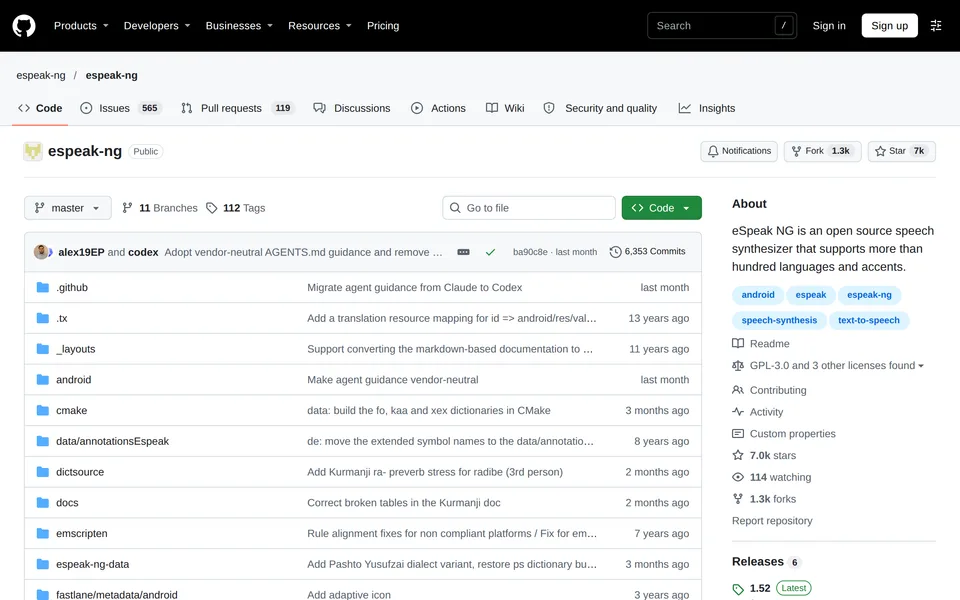
Screenshot from github.com/espeak-ng/espeak-ng, taken 2026-10-30, shown to help you recognise the tool. It belongs to its maker. Ask us to remove it.
The voice that read your bus times in 1998 is still around, and it runs in a few megabytes on nearly anything. eSpeak NG uses formant synthesis, and the project says that lets it stay small and run at high speeds, and it covers more than 100 languages and accents. The licence is GPL version 3 or later, with some Apache-2.0 and BSD-2-Clause parts.
eSpeak NG scores a 5 on footprint and lock-in, a 4 on self-direction, power and longevity and a 3 on delivery.
It grew from an engine written by Jonathan Duddington, passed through Reece Dunn's version in 2010 and became eSpeak NG in late 2015, and the page names no current maintainers. Formant voices sound more robotic than neural ones, so Delivery is a 3, and its quiet strength is that other tools use it, with Piper embedding it for phonemization and Kokoro asking for it as a dependency.
- A compact speech synthesizer covering more than 100 languages and accents
- GPL version 3 or later, descended from Jonathan Duddington's engine
- Sounds more robotic than neural voices, and other tools build on it
What stands out
Do you make eSpeak NG? Get the badge for your site
This badge reports a dated review. It is not a certification and it costs nothing. Link it to this page and leave the numbers alone: the image always shows the current score.
For dark backgrounds, use espeak-ng-dark.svg in place of espeak-ng-light.svg.
For comparison, we also reviewed ElevenLabs (16/30) as a benchmark.
Other tools for “hear text read aloud without a subscription”
 KokoroA small open-weight text-to-speech model with Apache-licensed weights that runs on modest hardware.
 PiperA fast, local neural text-to-speech engine you install with one command.
 SherpaTTSAn Android text-to-speech engine that uses Piper or Coqui voices and reads aloud with no connection.
 ChatterboxAn MIT-licensed text-to-speech model with voice cloning, from a company that sells voice AI.