
Open Interpreter
A terminal coding agent tuned to get strong results from cheaper open models, with commands run in a sandbox.
Instead of Claude Code, Codex
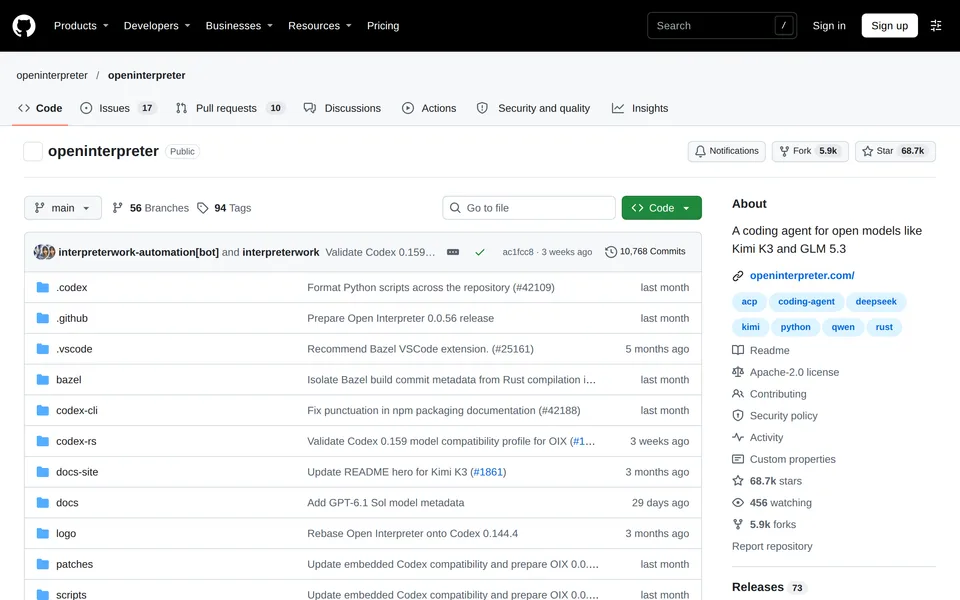
Screenshot from github.com/openinterpreter/openinterpreter, taken 2026-10-30, shown to help you recognise the tool. It belongs to its maker. Ask us to remove it.
Open Interpreter began as a Python project that let a model run code on your computer, and it has since been rebuilt from scratch, a good lesson in how fast this field moves. The current repository describes it as a coding agent for open models like Kimi K3 and GLM 5.3, a fork of OpenAI's Codex that imitates other agents' harnesses to get better results from low-cost models. You switch harnesses with /harness and models with /model.
Open Interpreter scores a 5 on lock-in, a 4 on footprint, self-direction, power and delivery and a 3 on longevity.
The code is Apache-2.0 and runs on Mac, Linux and Windows, with commands executed in a native sandbox on all three and state kept under ~/.openinterpreter on your machine. The page names no people or company, and says the original Python version lives on only as a community fork, so Longevity is a 3 for a project that has changed shape. It works with hosted providers that need credentials and with any OpenAI-compatible provider, and the page does not say whether the models themselves run on your machine.
- A terminal coding agent built to get good results from cheaper open models
- Apache-2.0, a fork of Codex, with commands run in a sandbox
- The original Python project survives only as a community fork
What stands out
Do you make Open Interpreter? Get the badge for your site
This badge reports a dated review. It is not a certification and it costs nothing. Link it to this page and leave the numbers alone: the image always shows the current score.
For dark backgrounds, use open-interpreter-dark.svg in place of open-interpreter-light.svg.
For comparison, we also reviewed GitHub Copilot (15/30) and OpenAI Codex (20/30) and Claude Code (17/30) as a benchmark.
Other tools for “code with an ai agent i control”
 AiderA terminal tool that pairs you with the language model of your choice, on new or old codebases.
 gooseAn open-source AI agent that runs on your machine and works with the model you choose.
 ClineAn open-source coding agent for your editor, terminal or desktop that asks before it changes anything.
 OpenCodeThe open source coding agent for the terminal, desktop and your editor, with any model provider you like.
 ZedA fast code editor where the AI features are optional and can be switched off with one setting.
 Kilo CodeAn open-source coding agent for VS Code, JetBrains and the terminal that charges model prices with no markup.