Ollama
Runs open AI models on your own computer and gives other apps a local server to use them.
Instead of Hosted chatbots such as ChatGPT
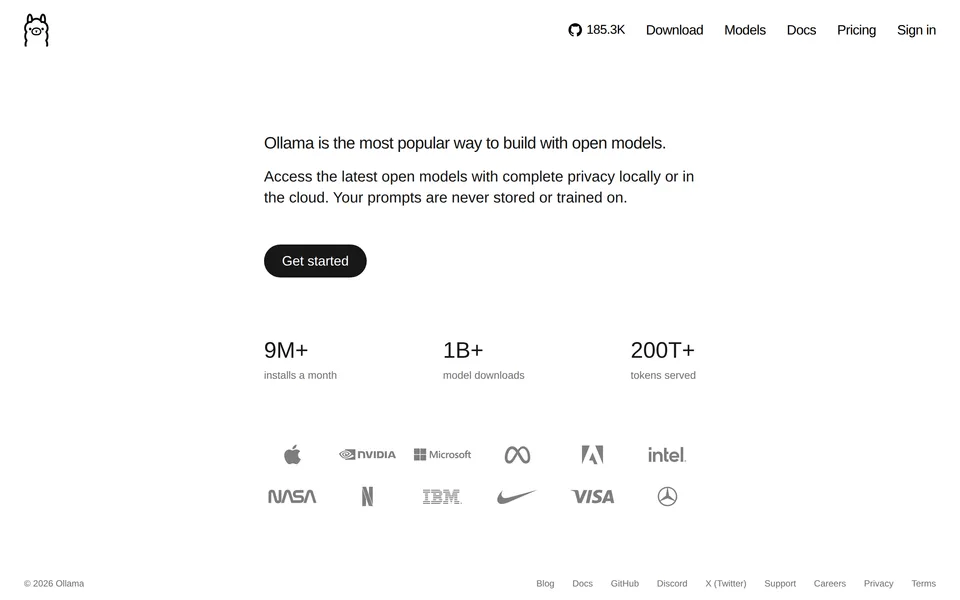
Screenshot from ollama.com, taken 2026-10-30, shown to help you recognise the tool. It belongs to its maker. Ask us to remove it.
There is a story in the history of the telephone about an undertaker in Kansas City named Almon Strowger, who became convinced that the local operator, who happened to be married to a rival undertaker, was sending his customers' calls to her husband. Whether it happened that way or not, Strowger went home and invented a switch that connected calls with no operator at all, so that nobody stood between a caller and the person being called. Ollama does something similar for artificial intelligence. Ordinarily, when you put a question to an AI model, a company's servers sit between you and the answer and everything you type passes through their hands. Ollama is a small program, released under the MIT licence, that downloads open models onto your own computer and runs them right there, with a local server on your machine so that other programs can talk to the model the way they would talk to a hosted chatbot such as ChatGPT. It comes as an installer for Mac, Windows and Linux, and as an official Docker image for people who like their software kept in tidy containers.
What you get for taking out the middleman is a kind of privacy that is hard to find any other way. With a local model your prompts stay on your computer, and you can change which model you use whenever the mood takes you, the way you might swap one lens for another on the same camera. What you give up is the comfort of somebody else's hardware. The better models want a capable machine, and on an older laptop you will be waiting a good while for answers or settling for a smaller model than you hoped for, which is why Ollama scores a 3 on footprint, while the open licence and the ease of swapping models earn it full marks for lock-in, and the fact that anyone is free to keep the code going earns it full marks for longevity.
There is a back door in the house, and it is only fair to point at it. Ollama's own page says you can also run models in the cloud, and a model in the cloud means your prompts leave your computer again, a bit like moving the telephone exchange back to the next town after you had gone to the trouble of bringing it home. We could not find out what those cloud options cost or whether they ask for an account, so anyone planning to use them should read that part of the page before relying on it. The company behind Ollama is the one that decides how the cloud side develops, and the local program under the MIT licence is a different matter, since the code is out in the world and a licence like that lets anyone carry it on if the company's plans ever drift.
Much of the pleasure of a tool like this is in how little it asks of you for being yours. You install it, you choose a model the way you would take a book down from a shelf, and the thing is there, answering from inside your own machine whether or not the network is up. The chore that comes with it is that you become the person who looks after it, deciding which models to keep and noticing when your machine is struggling, which a hosted service would otherwise do for you.
- Runs open AI models on your own machine behind a local server
- MIT licensed, with installers for Mac, Windows and Linux
- Cloud models are optional and send your prompts off your computer
What stands out
Do you make Ollama? Get the badge for your site
This badge reports a dated review. It is not a certification and it costs nothing. Link it to this page and leave the numbers alone: the image always shows the current score.
For dark backgrounds, use ollama-dark.svg in place of ollama-light.svg.
Side by side. Ollama vs ChatGPT
For comparison, we also reviewed ChatGPT (14/30) and Claude (15/30) as a benchmark.
Other tools for “chat with ai on my own machine”
 AnythingLLMA desktop or Docker app for chatting with your documents using local or cloud models.
 JanAn open-source chat app that runs AI models fully offline on your computer.
 LibreChatA self-hosted chat site that puts many AI providers behind one login you run yourself.
 ChatboxA desktop chat client that keeps your conversations on your own device and talks to the model you choose.
 KhojA self-hostable AI second brain that answers from your notes and the web with a model you choose.
 Open WebUIA polished self-hosted AI interface whose licence now carries a branding clause.