Project Gutenberg
More than 75,000 free ebooks from a volunteer library that started in 1971.
Instead of Kindle's free book section
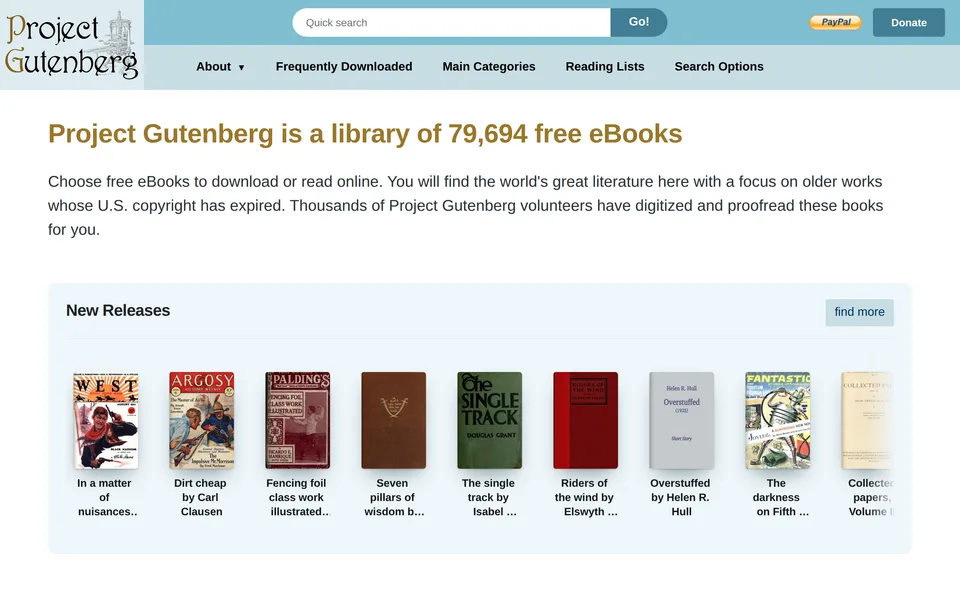
Screenshot from www.gutenberg.org, taken 2026-10-30, shown to help you recognise the tool. It belongs to its maker. Ask us to remove it.
The story goes that on 4 July 1971 a student named Michael Hart typed the United States Declaration of Independence into a computer at the University of Illinois, and called it the first ebook. Project Gutenberg grew from that. It now says it has more than 75,000 free ebooks and promises that they are free and always will be, with no fees, no registration and no ads, and thousands of volunteers have digitised and proofread the books since. A foundation runs it and takes donations.
Project Gutenberg scores a 5 on lock-in, power and longevity, a 4 on footprint and delivery and a 3 on self-direction. It is the oldest and biggest free library of its kind, and the books are plain files you can keep. It runs in any browser or on an e-reader.
The site looks its age and the formatting varies from book to book. Like the rest of the free shelf it holds older books, so anything new has to come from somewhere else.
A book from it is a file you can keep on any reader.
- More than 75,000 free ebooks from a volunteer library started in 1971
- No fees, no registration and no ads
- Plain files you can keep, though the formatting varies
What stands out
Do you make Project Gutenberg? Get the badge for your site
This badge reports a dated review. It is not a certification and it costs nothing. Link it to this page and leave the numbers alone: the image always shows the current score.
For dark backgrounds, use gutenberg-dark.svg in place of gutenberg-light.svg.
For comparison, we also reviewed Amazon Kindle (13/30) as a benchmark.
Other tools for “own my books”
 Standard EbooksFree, carefully made editions of public-domain books, with no account and no catch.
 CalibreManages, converts and reads your ebook library on your own computer.
 KOReaderAn open-source reading app for e-ink readers, phones and computers that opens almost any file.
 AudiobookshelfA server you run yourself for your audiobooks, podcasts and ebooks, with apps to listen on your phone.